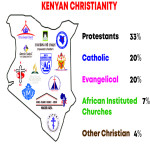
Statistically Kenya is one of the most Christian countries in Africa. Already in 1962 over 53 per cent of its population was Christian, and by 1972 the figure had risen to 66 per cent. The statistics in this Handbook reveal many startling facts, one of which is the large number of denominational groups and organisations in the country. Since there are 49 mission (or historical) denominations served by 70 Western Protestant missionary societies and 50 Catholic missionary societies and orders, 156 independent churches, 15 national church councils and conferences, as well as 10 inter-national church councils based in Kenya, this points clearly to the fact that Christianity in Kenya is by no means homogeneous.
Every major tradition of Christendom is represented in Kenya: Roman Catholicism, Anglicanism, Orthodoxy, Presbyterianism or the Reformed tradition, Lutheranism, Methodism, Independent churchmanship, Baptists, Quakerism, Seventh-day Adventism, and so on. Similarly, a number of theological positions are represented in the country, such as liberalism, fundamentalism, evangelicalism, reformationism, conservatism, radicalism, ecumenism, etc. And all this in such a small country as Kenya, all in the name of Christianity.
Christianity in Kenya has mushroomed denominationally, and the mushroom has now been turned into a messy soup. This excessive denominationalism is absolutely scandalous. It could well generate confusion and strife among Christians, and in the long run it will not be in the national interests of our country to tolerate and maintain this type of division precisely when we are attempting to create national unity. The denominational mushroom soup is boiling over and this invites someone to call a halt; and if that some- one is not the churches themselves, then it may well be the government. Christianity must not be allowed to become a cloak and cover for divisive ness in the country, and religious freedom must not be abused through this denominational proliferation which courts national disunity and throws shame upon an otherwise breathtaking expansion of the Christian faith in Kenya.
That church divisions are sinful there is no doubt; that many of them are created and sustained by the self-interests of church leaders cannot be denied; that the majority of African Christians do not know and do not care about the theological and historical grounds for these divisions is also undeniable; and that denominational division in mission churches is sustained through financial assistance from Europe, from Britain and America, is another fact that can be substantiated. We have been hypnotised into living with divisions in the church; we are made to fight harder to defend denominational Christianity than to spread the cause of the Gospel. We duplicate Christian service and our meagre financial and human resources of the church under the umbrella of trying to give an Anglican, or a Roman Catholic, or a Methodist witness. One group teaches this while another teaches something different, if not contradictory at times; one denomination allows smoking and drinking of alcohol while another body forbids them both; one sect admits into membership individuals from polygamous families while another excommunicates them or keeps them on the periphery of church membership; one group stands up to pray and sits down to sing while next door an- other group sits or kneels to pray and stands up to sing; one church uses incense, candles and Latin in church services while another condemns them all as idolatrous. What a cacophony of traditions and practices, as each denomination tries to proclaim its own glory that it and it alone holds the final truth of Christianity and is the emblem of the true church! Each group has a false image of itself and of the others.
Some people will argue quite rightly that each of the 210 or so denominations and sects in Kenya brings into the common church a particular tradition and ecclesiastical insights. This is fair enough. But must we pay the heavy price (I would say penalty) of denominationalism for the sake of these traditions and insights? Surely the same insights could be generated under one and the same church if given the freedom to exercise a diversity of taste, culture, situations and theological views. We do not have to disfigure the Body of Christ first, in order to claim that we have enriched it with different traditions.
Attempts have been going on since the early decades of this century to remedy this denominational mass proliferation. But the pace of these ecumenical discussions is so carefully guarded that one wonders whether we are not receding from rather than proceeding towards church unity in Kenya. In any case, when a new denomination or sect is formed every month, surely much more serious work has yet to be done in the ecumeni-cal direction to keep pace with, let alone overtake and reverse, this high rate of divisions. Even the National Christian Council of Kenya, founded as the CCK in 1943, is hardly anything more than an administrative organisation embracing only 21 of the 203 denominations in the country (this is 10.3 per cent of all denominations); the Evangelical Fellowship of Kenya is made up of the more fundamentalist groups of churches; the Kenya Independent Churches Fellowship, the United Churches of Africa, and other similar councils concern themselves with only a few of the independent churches in the country. Indeed this proliferation of councils only means that in addition to denominational divisions there are also groupings of churches along lines of theological taste and church government, to add to the confusion of the layman and to distort the already damaged image of Christianity that these many churches have given.
It seems to belong to the nature of the Christian faith that, in spite of these obvious divisions and their implications, the churches are making a living contribution to national life and to the life of the individuals who find spiritual refuge and hope under even their rugged umbrellas. Churches are not Christianity, even if they each proclaim something of Christianity. Christianity is not the churches. The Christian faith is not grounded on either the churches or even the religious system called Christianity itself. Because the nucleus of the faith is grounded and centred upon Jesus Christ, we can afford to have divisions in the church with all their shame and embarrassment, without necessarily missing the essence of the Christian faith. Christ is not divided even if His Church is divided and maimed a thousand times and more. We must admit that, in one form or another, each of these many denominations and churches is mediating Christ to the individual and to society at large. It is striking that the word 'church' is used in the names of almost all of these 210 denominations and sects, and even where it is left out it is implied in the use of other words. Thus each group shows a genuine wish and concern to depict the church of Christ, to witness to the fact of Christ as proclaimed in the universal church, and to be "the" or "a" church whatever else outsiders may think or whatever other image of itself it may give. The intention is there, and this intention to be the church is certainly a unifying factor even if organisationally the number of churches continues to mushroom.
Denominationalism and its proliferation, then, are the product of human selfishness and weakness. Our church leaders in Kenya, present and past, African and expatriate, have made a mess of the church through inheriting and agreeing to accept divisions, through multiplying divisions, and through perpetuating divisions. But the spirit of Christ is one of unity, reconciliation and harmony. This is the spirit which gives us the courage and confidence owe allegiance to Him in spite of, and beyond, the denominational walls. The essentials of the Christian faith have remained intact, so that the causes and the fact of denominational division are fundamentally peripheral to, and not an essential of, the Christian faith which otherwise is grounded on Jesus Christ who Himself is unchangeable and indivisible. Perhaps Kenya is learning to live above denominationalism and to reap the benefits of the Christian faith in spite of the divided churches on its soil; yet the nettle's sting of denominationalism remains, and as long as it is there no Christian can rest comfortably.
Finally, the information in this Handbook makes one wish to appeal the Government of Kenya to set up a ministry of religious affairs. It is not enough for the government simply to register the over two hundred church sects and denominations in the country, it is not enough to allow religious freedom in the country, it is not enough for the government and churches to co-operate in matters like education and religious broadcasting. A greater formal involvement is called for between the churches and the government, if the religious energy in the country is to be fully harnessed and utilised for the good of the country. In advocating that a governmental ministry of religious affairs be set up, I am aware that a lot of people, especially non-africans, will start shouting that this would bring about government interference in church affairs; but surely the kenya government is powerful enough to need no ministry for the sake of interfering in religious matters were that to be the case. If we can have ministries dealing with items like natural resources and tourism, is it not high time that we had a ministry to cater for the religious life of our peoples all of whom owe allegiance to a religious tradition? Can the government afford to ignore the presence of hundreds of church denominations in the country, over 66% of the population claiming to be christian, scores of western missionary societies, and dozens of international church councils based in Kenya, to say nothing of the many church projects in industry, urban life, mass media, women's organisations, relief work, refugees' concern, etc., without taking formal interest in the life and work of the churches and other religions in Kenya? It would be a grave loss to both the country and the churches as to other religious bodies, to continue much longer without the beneficial services that could be rendered through an effective, efficient and well- organised ministry of religious affairs. This Handbook shows that people in Kenya are not only keenly interested in religious life but are actively engaged in it. This religious picture calls, therefore, for a formal governmental recognition whatever outsiders may say about it. I hope that the Handbook will stir up serious thinking in this direction, and that the Government of Kenya will be bold enough to take this courageous step forward in the interests of its people and in appreciation of the value that African peoples attach to religion.
This is an excerpt from Kenya churches handbook; the development of Kenyan Christianity, 1498-1973
https://africansdahistory.org/wp-content/uploads/2018/04/Kenya-Churches-Handbook-1973-Africa.pdf